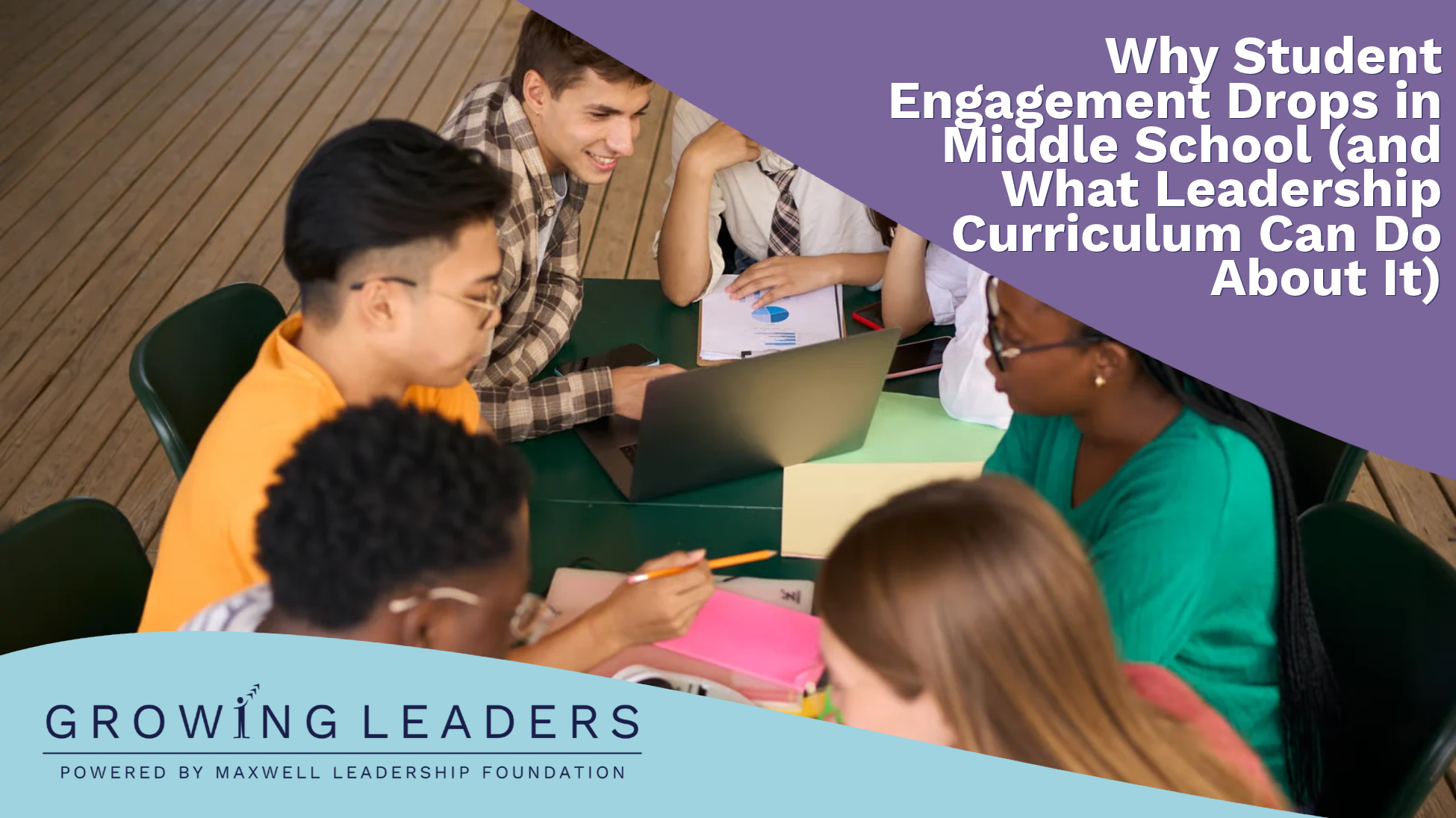
The drop in engagement that occurs as students progress through middle school is confusing to educators. You go to your fifth grade classroom and you are filled with eager kids who raise their hands, listen and want to be there. When you return to this same classroom in seventh grade it will be much less engaged. If you were in middle school, you would think, “This doesn’t seem like something I could solve with a new set of rules, maybe I’m imagining it.” It is not your imagination. What you need is a student engagement curriculum for schools that takes students beyond discipline and meets them where they are developmentally.
Why Engagement Drops in Middle School
For about 10 years Gallup has been polling students about their engagement and has some interesting data on what researchers call the engagement cliff. Student engagement peaks in fifth grade; nearly three quarters of students are interested in school and excited about school (Gallup). But over the next few years, this number gradually declines and reaches a low point at eleventh grade (Gallup). A similar trend was seen in school data in New South Wales. Students’ effort, their attachment to achievement and their sense of belonging did drastically decrease from Year 6 to Year 7 when students moved from elementary to middle school structures (NSW Department of Education).
These are not signs of disengaged middle schoolers, but rather signs of a developmental need that is not met in most classrooms.
The Top Three Reasons Why Students Lose Engagement
They move from what should I do to who am I?
At the age of 11-14 students start to enter the “identity formation” stage. They begin to question who they are and who they want to be. School was once the whole world but now it’s just one part of a bigger internal project. And it’s not realistic that they will be so excited to go to school like they were when they were young because a curriculum based on memorization and compliance doesn’t meet that developmental need.
Their peer group is more important to them than any adult in their life.
At the same time middle schoolers are constantly assessing their place in their friend groups and how they compare to their peers. Classes based on individual work and teacher-driven work ignore the single most powerful force in an adolescent’s daily life. When the classroom is peer-led it works with that force instead of against it.
They need a sense of internal motivation.
As students move through school, their classroom environment is not meeting their needs for autonomy, competence and connection (based on Self Determination Theory). Elementary school classrooms do a great job of creating a warm environment that is conducive for students to choose, but middle school classrooms remove autonomy-inducing elements at the moment students are most in need of them.
A Traditional Academic Curriculum Fails to Meet Developmental Needs
Most traditional curriculums are designed to answer “what does this student need to know?” and rarely answer “who does this student need to become?” That is why it’s so hard to get buy-in from middle schoolers. In any case, no matter how well-rounded your math curriculum is, if students don’t feel like they have a choice, control or connection in the classroom, they’re not going to care.
Traditional Behavior Management Only Makes the Problem Worse
You are just dealing with the symptoms that you have by emphasizing rules and structure. So if you’re not meeting students’ developmental need for autonomy, you’re not going to turn disengaged middle schoolers into engaged middle schoolers no matter how many rules you write.
But when students actually have control over their environment, everything changes. That’s why a student engagement curriculum like Growing Leaders’ iLead curriculum can change the dynamic. Students are not just sitting in the classroom listening to a teacher. They are leading discussions and working with others on real-world challenges. The iLead Middle School curriculum is created for this moment in a student’s life and it taps into that developmental need: peer-led, values-based discussions. When a seventh grader leads the discussion instead of just receiving one, you begin to see a change in the classroom where:
- Their natural developmental need for identity formation is met.
- Their natural developmental need for peer connection is met.
- Their natural developmental need for internal motivation is sparked by providing autonomy, challenges, and working with their peers.
That is what Growing Leaders means when they say turning rows of passive learners into circles of courageous, values-driven leaders. It meets students where they are developmentally.
Character That Sticks, Starting at the Root
For schools that have implemented peer-led, research-backed programs like iLead, the shift in classroom culture is evident. According to Growing Leaders’ own data, 92% of educators report a stronger classroom culture after just one cycle of the iLead program (Growing Leaders). That’s what happens when curriculum finally speaks to the developmental moment students are actually in.
The drop in school engagement during middle school is not a sure thing. It’s not that students stop caring about school, but that when opportunities to have them lead and control their environment cease. Give those opportunities back and engagement can follow. Are you ready to change that?
What is the way to bridge the gap between student engagement and a great leadership curriculum? Learn how iLead Middle School is helping students to lead themselves first, and lead each other next. And see how schools are building a stronger culture and deeper engagement, one circle at a time. See growingleaders.com for the iLead Middle School program.