
A Middle School Counselor in Ohio shared years ago a story that still resonates with us. Her school had invested heavily in social emotional learning and so many of her students could describe their feelings, use emotional regulation techniques and discuss conflict resolution with a sophistication that was astonishing. But one day a group of eighth graders witnessed a classmate being mocked in the cafeteria. Each one of them could recognize what was happening. Each one of them could articulate the uncomfortable feelings that arose in them. And yet each one of them remained seated.
It was then that we realized what social emotional learning doesn’t necessarily address: the courage to act upon what one knows. That is why the conversation about social emotional learning + leadership curriculum is so important.
What SEL Does Well
Social emotional learning has flourished in schools for a reason. Built largely on the framework from the Collaborative for Academic, Social and Emotional Learning (CASEL), SEL focuses on five core areas of student success (self-awareness, self-management, social awareness, relationship skills, and responsible decision-making). It is so that students can better understand themselves, their emotions and behaviors, relate with others and make sound decisions.
And yes, these are important things for schools to focus on and in fact, we believe SEL provides the emotional foundation for all students. A student who doesn’t have self-management skills, for instance, might struggle to lead a class project effectively. And a student who doesn’t have empathy will probably struggle to convince his/her peers to support his/her cause.
But while SEL provides a solid foundation, a foundation is not the whole building.
Where the Gap Opens Up
Social emotional learning was created to help students see themselves and the relationship with others. However, it was not designed to answer the question of what to do once you know yourself and others. Recognizing the need for intervention in the real world is not the same as intervening in the real world. Knowing what is right is not the same as doing what is right. This is why we think a values-based leadership curriculum is a great complement to SEL.
At Growing Leaders, we believe everything rises and falls on leadership, and that leadership is influence, not position. Which is why a well-rounded, emotionally intelligent student can still walk past injustice if nobody has ever taught them that their voice matters. A moral identity is a student’s personal set of values that are deeply rooted and strong enough to withstand peer pressure, indecision and the temptation to just go along. To put it simply, SEL builds emotional competence and a values-based leadership curriculum builds moral identity.
An SEL lesson might have students reflect on how they felt when they saw their peers being excluded. In an iLead (Growing Leaders’ K-12 leadership program) lesson, students would need to define what values are at stake, decide what kind of person they want to be, and practice out loud, with peers, what they would actually say. One builds awareness. The other builds action.
Moral Identity Is Not the Same as Emotional Competence
Emotional competence tells you how to regulate a feeling. Moral identity tells you why you should act on a conviction, even when it costs you something.
Research on adolescent development suggests that knowing what is right and doing what is right are governed by different processes, and character formation plays a big part in helping students bridge that gap.
That is why Growing Leaders emphasizes self-leadership before we focus on leadership of others.
In short, we want students to have the character to follow their own values before we ask them to influence others to follow their values. By focusing on self-leadership first and leadership of others second, we move character development out of just knowing the right thing to do and into the realm of actually doing the right thing.
Circles of Awareness and Circles of Courage
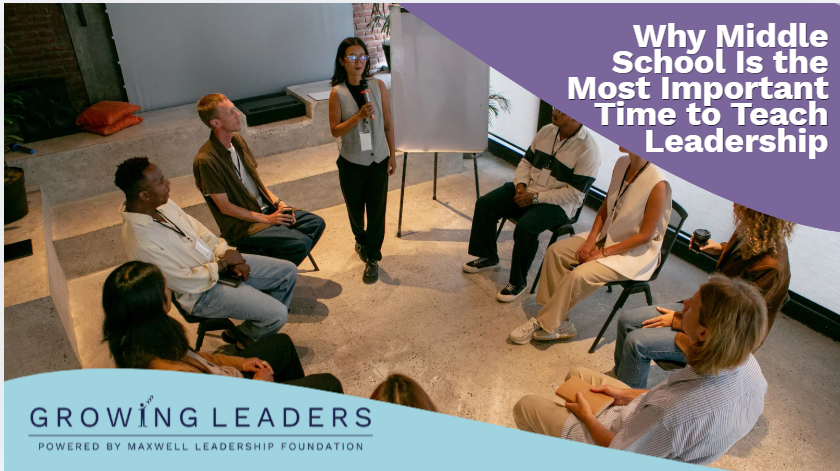
Imagine two circles. In one, students come together to get to know themselves and process feelings together, while in the second one, students stand up and take action on issues that really matter to them. That’s the difference between social emotional learning and leadership curriculum: one is about awareness and the other is about building action. SEL is really the “circle of awareness” and leadership curriculum is the “circle of courage.” Growing Leaders exists to turn rows of passive learners into circles of courageous, values-driven leaders, and that is why we believe the two are so closely linked.
Schools that stop at SEL create students who are emotionally fluent but civically passive.
These are students who understand what is going on but are unlikely to do something about it. Schools that go beyond SEL and incorporate leadership curriculum, on the other hand, tend to see students who move toward solving problems, not just understanding them. That’s because students who have been exposed to leadership curriculum know that leading and serving in their schools and their communities is important. So they also have the skills to do so and they are tested and honed in low-risk environments like advisory periods, clubs, and CTE tracks long before the stakes get high. And it’s the combination of SEL and leadership curriculum that allows schools to graduate emotionally intelligent students who put their heart and effort into making a difference.
The Case for Both
We hope by now we can make clear that we are not against SEL. In fact, we are huge proponents of it. We simply think SEL alone isn’t enough, and we have created iLead. Schools that have both SEL and leadership curriculum have the best of both worlds and so we have seen strong student outcomes. For example, one Rwandan principal built a program that reached 3,000 students over five years. Another initiative in Argentina has trained more than 200,000 leaders to help to impact even more change in their communities.
If your school has built a strong SEL foundation, you are not behind. It is a great foundation from which to build even better student outcomes. The best school cultures we have seen are those that have combined SEL with leadership curriculum. If you bring leadership into the SEL model, you’ll start to see students lead. Every school serious about developing the whole student eventually asks the same question: our students understand their emotions, so how do we help them lead? Find out how Growing Leaders’ K-12 leadership curriculum can support your SEL efforts by visiting growingleaders.com.