
If you stand in a sixth grade hallway for five minutes and see the formation of identities take place right in front of you, you will see the boy who always raised his hand in class stop making eye contact with the teacher. The friend group who promised they would always be paired together until graduation splits apart by September. A girl tries on three different identities before lunch, each one discarded by dismissal.
And this is not chaos for its own sake. This is the growth of identity happening right in front of you, whether you plan for it or not. And that is why a leadership curriculum for middle school should be prioritized in your advisory time, not left for high school where students may only have the chance to apply it long after they have chosen their college major.
School leaders often ignore middle school as a time for building leadership skills, and think students will not truly need these skills until they’re in college or running for office, by which point there’s far less time left to develop core habits of character.
The Identity Window is Narrower than You Think
Early adolescence, social scientists have observed, is a time of crystallization, when youth start to solidify their sense of self and an emerging view of their own values, autonomy, and social relationships that persist into adulthood (ERIC).
Peer relationships can be social comparators and motivators, and adolescents have the strongest relationships with their peers during this time period (ERIC), so peer interactions are not a distraction from learning during middle school. They are learning opportunities, whether educators plan for them or not.
In early adolescence, students are even more influenced by their peers and are driven to belong to something bigger than themselves, and that can be an issue for middle school educators. A twelve year old asking the question “Who am I?” is also asking, what values do I hold and who will share them with me? If a student can’t establish their own value system at this age, they will take one from the strongest influence they have, their peers.
Character Built Now Is Character That Lasts
Leadership is influence, not position, and influence has to do with the character you bring to the table, beginning with who you are. Self-leadership is one step toward influencing others. The students who learn those skills at this stage will retain those competencies for life.
This is especially true in the context of self-leadership. Self-leadership is important at every age, but it becomes particularly important for high school or college students, who are expected to hold on to what they think is right even as the people and pressures around them make that harder and harder to do. High school leadership programs can teach students leadership skills but if students only start then they’ll have months of real-life experience as leaders instead of years. A 12-year-old with years of experience in self-leadership is less likely to get derailed by these problems because she’s already had a lot of experience in middle school.
It’s not just theory. It’s common sense. Everything rises and falls on leadership and nowhere is that easier to see than at a school that decided to test it. One principal in Kigali, Rwanda pioneered age appropriate leadership development for about 3,000 students, and the impact of that leadership was felt throughout the student population and even beyond. And students had been practicing leadership for years in that school and the culture in the whole school got completely different after five years when staff recognized that leadership development was not just something you did to students but something you practiced with them. The exponential impact of leadership development for early adolescents is especially important to consider, as students are likely to exercise more agency over their own development if they can see the ability to influence their peers.
They don’t want to be managed. They want to matter.
Youngsters in early adolescence are not too young to learn leadership. In fact, these students are perfectly prepared to learn, practice and even teach leadership skills to their peers. What middle schoolers are not prepared to do is sit in rows and learn from one authoritative figure. They want to know that they matter and that we can make it happen when we challenge them to be part of shared leadership.
This can start at school. Students in rows face forward; their attention is trained to one authority figure at the front of the room. Students are passive in learning as well by looking forward. They listen to the teacher who talks at them, not interacting directly.
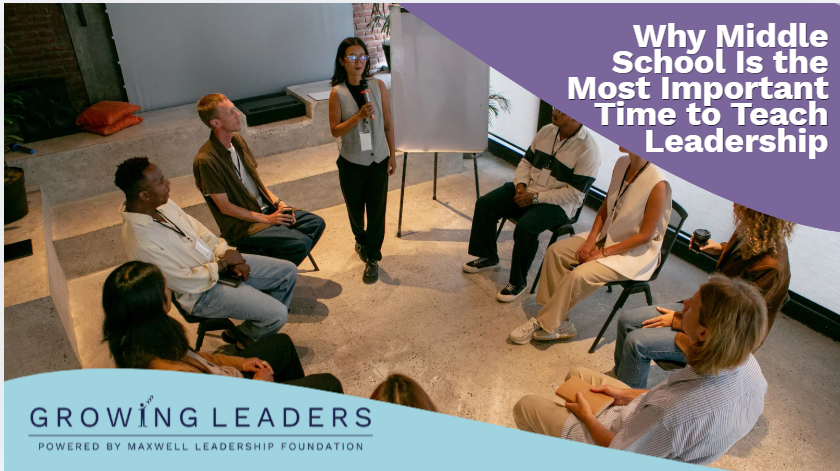
A circle allows students to talk to each other and not just to the authority figure. Looking at their peers provides students with a completely new path to learning in which they think about who they are and how they relate to others in the context of shared leadership. The transition from rows to circles is the step from passive listening to active engagement, starting with how we structure our advisory spaces to invite students to practice shared leadership from the very beginning.
Young middle schoolers are not too young to be learning leadership. It’s the right age to learn leadership. It’s the last time to encourage students to form new habits before long-standing identities start to calcify, and it’s the last time to invite students into shared leadership before they’re placed in positions of authority over others.
Put Your Advisory Investment Where Your Leverage Is
If your school wants to make the most out of the limited advisory time, the developmental research on early adolescence shows that earlier is better for character building. A leadership curriculum for middle school can take advantage of the developmental period for character and identity formation to prepare students to practice self-leadership before they enter high school. That’s an enormous value for schools because it puts students in a position to influence others, and as such they’ll get to experience self-leadership on a long-term basis and then deal with difficult ethical dilemmas in high school.
What does this look like in action? For the full details, go to growingleaders.com.